
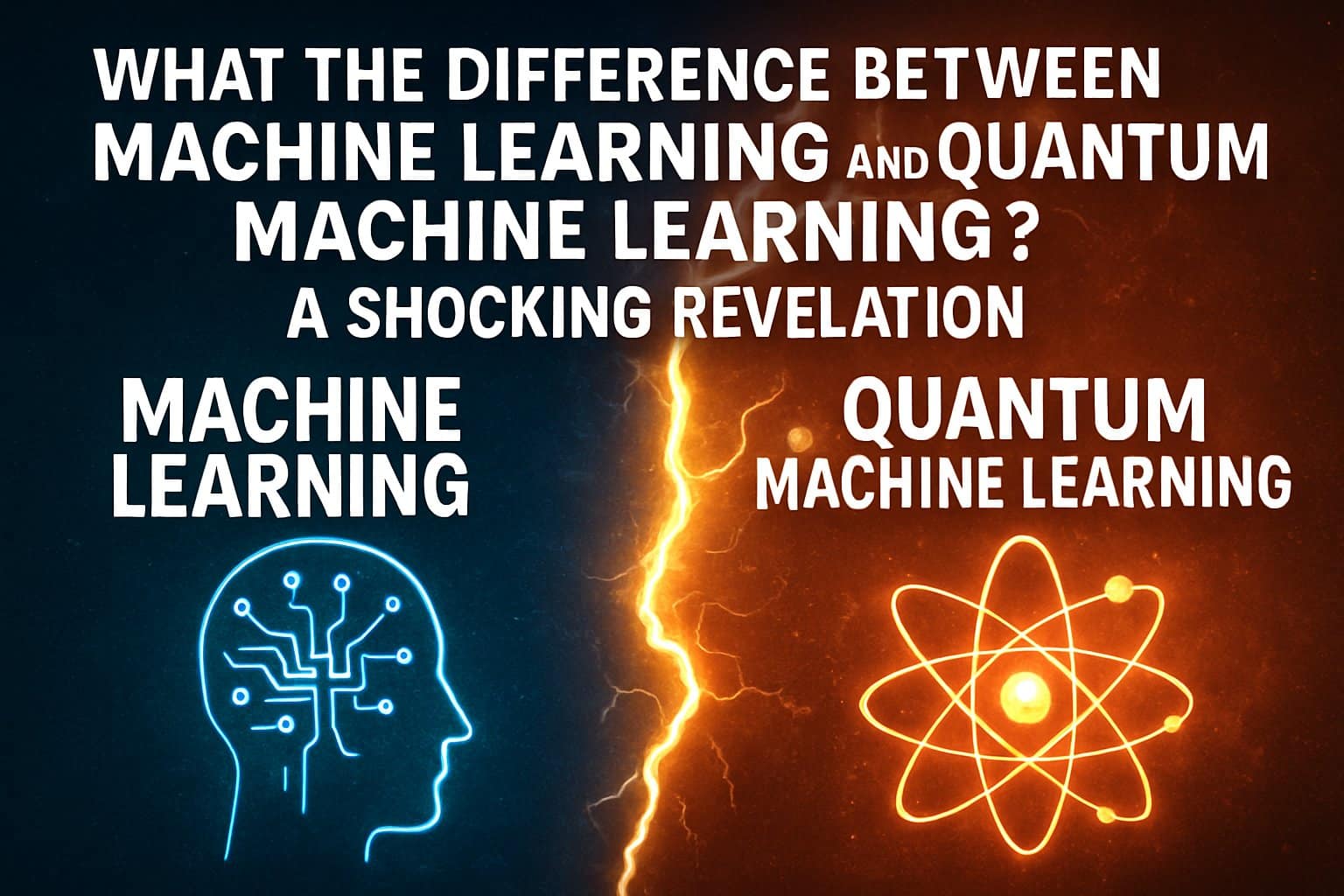
Have you ever wondered how machine learning, which powers everything from your smartphone to Netflix recommendations, is now evolving into a revolutionary new form? Yes, we’re talking about quantum machine learning, poised to take the tech world by storm! But wait—do you know the difference between machine learning (ML) and quantum machine learning (QML)? If your answer is no, then this article is nothing short of a treasure trove for you. We’ll bring you unique and exciting insights you won’t find anywhere else, delivered in such a fun way that you’ll want to stick around till the very last word
READ ALSO How Agentic AI Is Transforming Small Businesses in 2025: Save Time, Money, and Stress
Machine Learning: The Magic Transforming Our Lives
Let’s start with the basics: what exactly is machine learning (ML)? In simple terms, ML is a technique that teaches computers to learn from data without explicit instructions. For example, when you listen to a song on YouTube, ML suggests the next one based on your preferences. Pretty cool, right
Machine Learning processes data, finds patterns, and makes predictions. Whether it’s filtering spam emails, recognizing faces, or driving autonomous cars—ML is everywhere. But it has a limitation: it requires tons of data and time. For complex problems, it can be slow. Still, by 2025, the ML market has crossed $300 billion (based on Statista’s 2024 projections), and it’s reaching new heights every day. But something is coming that could give ML a run for its money. What is it? Let’s find out
Quantum Machine Learning: The Superpower of the Future
Quantum Machine Learning (QML) sounds as complex as it is thrilling. It’s an advanced version of machine learning that harnesses the power of quantum computing. Now you might be wondering, what on earth is quantum computing? Think of it this way: regular computers work on a binary system of 0s and 1s, but quantum computers use qubits, which can be 0, 1, or both at the same time. Thanks to quantum properties like superposition and entanglement, they can perform calculations millions of times faster
QML runs machine learning algorithms on quantum computers, solving complex problems in the blink of an eye. For instance, analyzing molecules for drug discovery, predicting weather with pinpoint accuracy, or breaking cryptographic codes in cybersecurity—QML is a game-changer. In 2025, companies like IBM and Google are pouring massive investments into QML. Recently, IBM launched a 127-qubit processor, a milestone for QML
But here’s the shocking part: QML is still in its early stages. It might take another 5-10 years for its full potential to be realized. Yet, its future is so bright that scientists are calling it “the next big bang in technology
Machine Learning vs. Quantum Machine Learning: What the Real Difference?
Now, let’s get to the question you’re eagerly waiting to have answered: what’s the difference between Machine Learning and Quantum Machine Learning? We’ll break it down in a simple and engaging way to clear all your confusion
Processing Power: Machine Learning runs on regular computers (CPUs or GPUs), which can take hours or days to process complex data. Quantum Machine Learning, on the other hand, runs on quantum computers, which, thanks to superposition and entanglement, can perform millions of calculations simultaneously. For example, where ML takes 10 hours to train a model, QML can do it in minutes
Data Handling: ML needs massive amounts of data for accurate results—the more data, the better the model. But QML can deliver stellar results with less data because quantum algorithms identify patterns much faster
Beyond these two points, there are several other differences, which we’ll explore in the paragraphs below,What the Difference Between Machine Learning and Quantum Machine Learning? A Shocking Revelation
Machine Learning relies on traditional algorithms like linear regression, deep learning, and support vector machines, which work in a straightforward manner. In contrast, Quantum Machine Learning uses advanced algorithms like quantum neural networks and quantum support vector machines, which are capable of solving complex problems faster. This difference lies in the structure and functioning of the algorithms, making QML more suitable for future technologies.
In terms of availability, ML is everywhere. You can train an ML model on your laptop, and services like AWS or Google Cloud make it even easier. But QML is currently limited to research institutions and big tech companies like IBM and Google because quantum computers are rare and insanely expensive. Cost-wise, ML is relatively affordable, allowing you to build models on a budget. QML, however, requires quantum hardware and maintenance that cost millions of dollars, keeping it out of reach for the average person for now.
When it comes to applications, ML meets today’s needs—whether it’s online recommendation systems, image recognition, or chatbots. But QML is built for the future’s big challenges, like discovering cancer drugs, climate modeling, or taking cybersecurity to the next level. In short, ML is our present, and QML is our future
Will QML Completely Replace Machine Learning?
This is the question buzzing in every tech enthusiast’s mind. So, what’s the answer? Probably not, at least not in the next decade. Machine Learning is still fantastic for small and large problems, and it’s easy and cost-effective to use. QML, on the other hand, is for complex problems that ML can’t handle. For example, in 2024, Google demonstrated a QML model that analyzed a complex chemical structure in seconds—a task that would take ML months! But here’s the twist: quantum computers are still “noisy,” meaning they produce a lot of errors. Scientists call this the “NISQ” (Noisy Intermediate-Scale Quantum) era. Until these errors are reduced, QML’s full potential won’t be unlocked
What Does This Mean for You?
Whether you’re a student, professional, or just a tech enthusiast, understanding Machine Learning and Quantum Machine Learning is crucial for the future. If you’re learning ML, don’t worry—it’ll remain relevant for the next 10-15 years. But if you want to do something revolutionary, keep an eye on QML. Courses like “Quantum Computing Basics” on Coursera or edX are great places to start,What the Difference Between Machine Learning and Quantum Machine Learning? A Shocking Revelation
Conclusion: Who Will Win?
The difference between Machine Learning and Quantum Machine Learning isn’t just about technology—it’s about the possibilities of the future. ML is our present, dominating every corner of our lives. QML is our future, promising to make the impossible possible. So, are you ready for this technological revolution? Or are you still thinking this is all too much to handle? Share your thoughts in the comments, and if you loved this article, don’t forget to share it. After all, who wouldn’t want to seize the chance to understand the technology of the future