
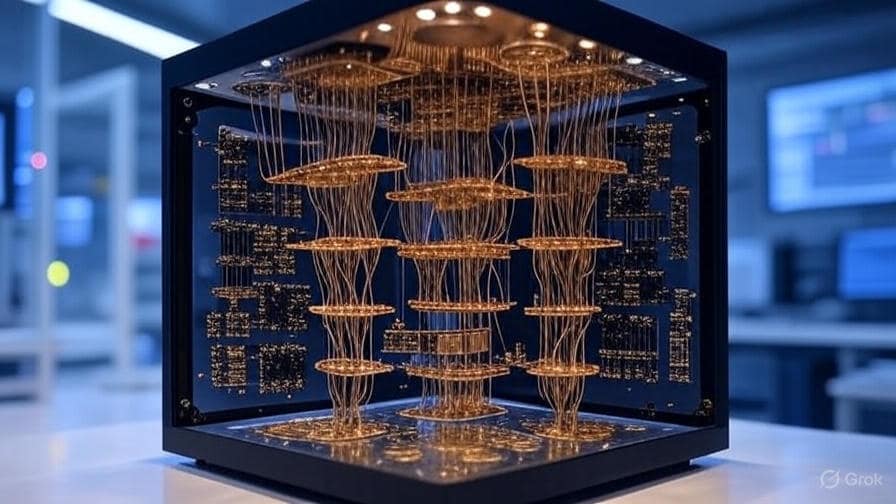
The term quantum computing conjures images of a sci-fi movie—complex machines, glowing qubits, and calculations that make the impossible possible in seconds. But this is no fictional tale. In 2025, quantum computing is rapidly becoming a reality, with the potential to revolutionize fields like cryptography, medicine, and artificial intelligence. This article dives deep into quantum computing, exploring its core principles, current progress, challenges, and future possibilities. We’ll also address common questions to simplify this complex topic for you
READ ALOS :Generative AI: The Future of Creativity and Innovation in 2025
What is Quantum Computing?
Quantum computing is a technology that leverages principles of quantum mechanics—such as superposition, entanglement, and interference. Traditional computers use bits (0 or 1), but quantum computers use qubits, which can exist as both 0 and 1 simultaneously due to superposition.
For example, two bits can represent four states (00, 01, 10, 11), but two qubits can represent all these states at once. As the number of qubits increases, computational possibilities grow exponentially. This allows quantum computers to solve certain complex problems in seconds, which could take traditional supercomputers millions of years.
How Does Quantum Computing Work?
Quantum computing relies on three main principles:
- Superposition: Qubits can exist in multiple states simultaneously, enabling parallel computations. It’s like exploring millions of paths at once.
- Entanglement: Qubits can be linked so that the state of one instantly affects another, no matter the distance. This helps quantum computers process complex data relationships quickly.
- Quantum Gates: These operate on qubits, similar to traditional logic gates, but they are reversible, making computations more powerful.
To maintain qubit stability, quantum computers are kept at extremely low temperatures (colder than outer space). Google’s Willow chip, launched in 2024, is an example. It completed a calculation with 105 qubits in five minutes, a task that would take a supercomputer 10 septillion years
Current State of Quantum Computing
In 2025, quantum computing is still in its early stages, but progress is rapid. Companies like Google, IBM, and D-Wave are investing heavily in quantum hardware and software. Key milestones include:
- Google’s Willow Chip: A major step in quantum error correction, reducing errors exponentially as qubit numbers increase, reaching the “below threshold” stage.
- IBM’s Qiskit: An open-source software that allows developers to create and test quantum circuits, making it the world’s most popular quantum SDK.
- Microsoft and Quantinuum: They achieved an error rate of 2/1000 with 12 logical qubits, another significant milestone.Quantum Computing: The Future Technology That Will Change the World
However, these systems are still at the laboratory level. Commercially viable quantum computers require hundreds of logical qubits and error rates below 1/1,000,000.
Applications of Quantum Computing
Quantum computing has the potential to transform multiple industries:
- Medicine: Quantum computers can simulate complex molecular interactions, accelerating drug discovery. For instance, Google and Boehringer Ingelheim simulated the Cytochrome P450 enzyme, which determines drug effectiveness.
- Cryptography: Shor’s algorithm can factor large numbers quickly, threatening current cryptographic systems and increasing the need for quantum-safe cryptography.
- Energy: Google, in collaboration with Sandia National Laboratories, showed that quantum algorithms can improve fusion reaction simulations, paving the way for clean energy.
- Artificial Intelligence: Quantum machine learning (QML) can process complex datasets faster, such as analyzing radiological images for cancer detection.
- SEO and Digital Marketing: Quantum computing can enhance data analytics and optimization, making SEO strategies more effective.
Challenges and the Future
Quantum computing faces significant hurdles:
- Error Correction: Qubits are highly sensitive to noise (e.g., electromagnetic waves). While Google’s Willow chip has made progress, more work is needed.
- Scaling: Building stable, large-scale qubits is challenging. A computer with 1 million qubits remains a distant goal.
- Cost: Quantum computers require expensive equipment like dilution refrigerators to maintain ultra-low temperatures.
Despite these challenges, experts predict commercial applications by 2030, achieving “quantum advantage” where quantum computers outperform classical ones for specific problems.
Conclusion
Quantum computing is not just a technological innovation; it’s opening a new frontier for humanity. It holds the potential to solve complex problems, transforming medicine, energy, and the digital world. While it requires time and investment to reach its full potential, quantum computing is a field to watch closely—it’s the future, starting today
FAQs
What is the difference between quantum computing and traditional computing?
Traditional computers use bits (0 or 1), while quantum computers use qubits, which can exist in multiple states due to superposition, making them faster for certain complex problems.
- Can quantum computers break existing cryptography?
Yes, Shor’s algorithm can break systems like RSA. This is why quantum-safe cryptography is being developed. - When will quantum computing see commercial use?
Experts estimate commercial applications in fields like drug discovery by 2030, with broader use taking longer. - Can I learn quantum computing now?
Yes, platforms like IBM’s Qiskit and Google’s online resources offer tools for beginners to learn quantum programming. - Will quantum computers completely replace traditional computers?
No, quantum computers are better for specific problems, but traditional computers will remain suitable for everyday tasks.